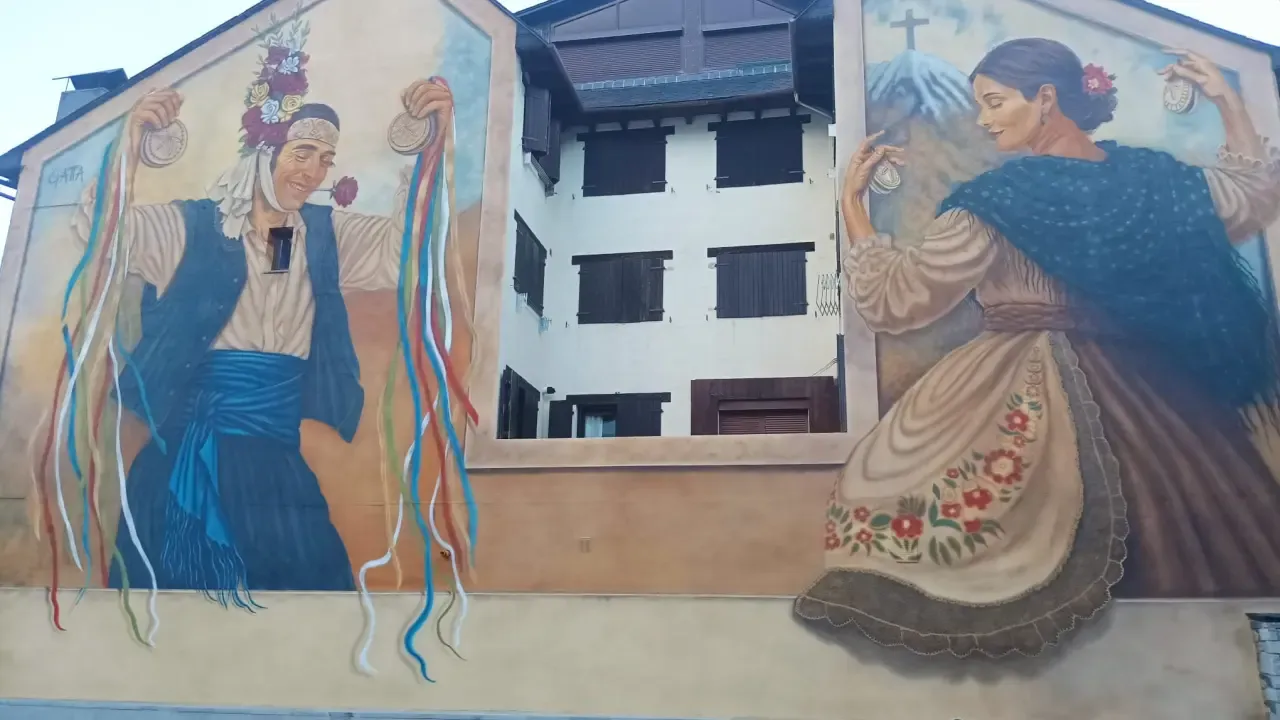
Benasque has a new urban landmark. A mural measuring 13 metres high by 20 metres wide covers the double façade on the square of the Pedro Pascual Science Centre of Benasque. The work, commissioned by Benasque Town Council, is dedicated to the Ball de Benás.
Its author is David Gatta, an airbrush artist from Barbastro who, in 12 days of work, has produced a strikingly realistic piece full of detail. It is not his first work in the Ribagorza: a couple of years ago he created another large mural on the Tournefeuille square in Graus.
On the left-hand side, Gatta has depicted a Benasque steward with flowers on his head playing the castanets with their coloured ribbons; on the right stands the dona de Benás, dressed in the traditional costume, performing the dance. In the background, as a Pyrenean backdrop, the Aneto and its summit cross.
What the Ball de Benás is
The Ball de Benás (or Ball de la Cabesèra) is a traditional dance of the valley, rooted in the festivals of its villages and documented since the 19th century. More than a folk spectacle, it is a living expression of community identity that is renewed every year: music, memory, celebration and generational handover among those who keep it alive.
Its main occasion is 30 June in Benasque, during the festival of the patron saint, San Marsial. After the procession, the men dance the Ball dels Omes in the square; the next day it is the women who take the lead in the Ball de les Dones, in a continuity that underlines the intergenerational character of the tradition. The same dance is also celebrated in other villages of the valley, such as Eriste (Ball de Grist, on 1 August) and Sahún (Ball dels Sombrers, on 8 September).
Its hallmarks are unmistakable: the large boxwood castanets decorated with coloured ribbons mark the rhythm, while the dancers wear bunches of flowers fastened to their heads with kerchiefs, a symbol of renewal and of the community’s continuity. The choreography unfolds in several parts and culminates in les marradetes, with its characteristic zigzag and spiral movements (fen el cargol) that evoke the comings and goings across the mountains. The stewards lead the dance and symbolically pass the baton to their successors by handing over flowers.
In 2025 the Ball de Benás was recognised as an Asset of Tourist Interest of Aragon, a tribute to a practice that survives thanks to the continuous participation of the community, generation after generation. The new mural on the Science Centre square now brings that tradition into the public space, for residents and visitors alike, all year round.
You can check the valley’s upcoming festivals and celebrations in our events calendar.